

Fall is the Season of Texture - and your arrangements should show it
Fall Is the Season of Texture, and Your Arrangements Should Show It
Every October someone sends us a photo of a fall arrangement and asks why it looks just okay. It's usually orange, red, some gold, maybe a sunflower. Nothing is technically wrong with it. It just looks like a picture of flowers instead of flowers.
Nine times out of ten the fix isn't color. It's texture.
Summer lets you get away with a bucket of the same round bloom in five colors. Fall doesn't work that way. Fall is corduroy and wool sweaters and leaves crunching under your boots. It's the lumpy squash at the farm stand and the velvet on a late season bloom. The arrangements that stop people in their tracks this time of year borrow that same mix, and fall is the one season where the cooler is actually stocked for it.
Why arrangements end up looking flat
A flat arrangement is almost always one where every stem has the same surface and sits at the same depth. Your eye has nothing to catch on, so the whole thing reads like wallpaper.
Put a velvety bloom next to a glossy one next to a cluster of berries and something changes. Light hits each of them differently. Glossy petals bounce light forward, so they seem closer to you. Velvet soaks light up and looks darker, so it seems to sit further back. Berries throw tiny shadows between themselves. Your brain reads all of that as depth, even in a vase that's eight inches across.
So here's the rule we use in the shop: count your surfaces, not your colors. Before you call an arrangement done, check that you have something smooth, something ruffled, something bumpy or clustered, and something that breaks the outline. Hit all four and it's nearly impossible to make a boring arrangement.
The textures we reach for every fall
Velvet: Celosia. Cockscomb celosia looks like crushed velvet folded into coral. It's dense, it's soft to the touch, and because it absorbs light, it's the best flower you have for creating shadow. Tuck it low and deep into the arrangement and suddenly everything around it looks like it's floating forward.
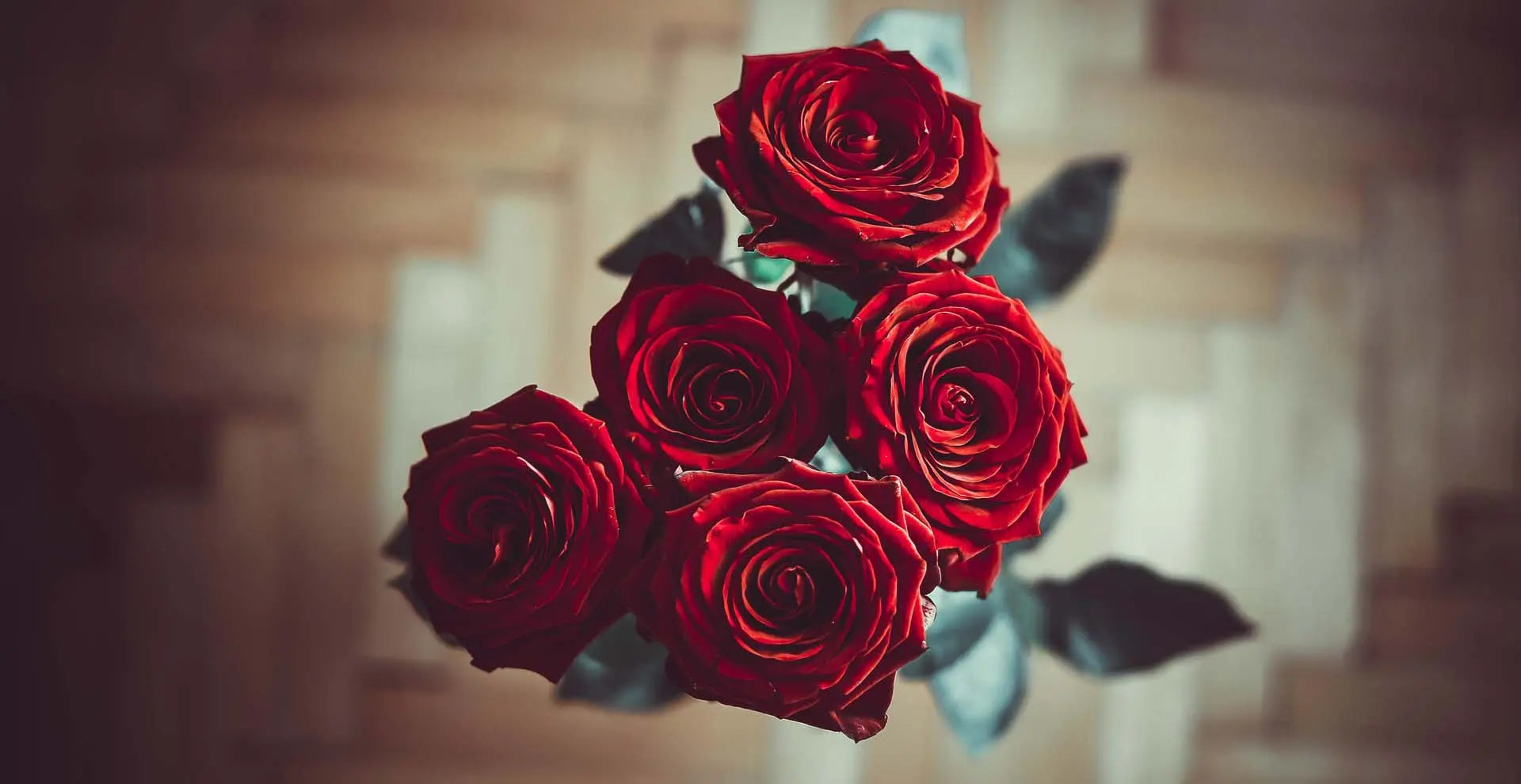
Ruffles on ruffles: Garden roses. Fall is when we stop reaching for polite pastels and go bold. Tess is a deep blackcurrant red that looks almost black in the center. Darcey is raspberry. Caramel Antike is exactly what it sounds like, caramel and cream, and it's probably the most "fall" rose we carry. Juliet and Effie bring apricot and buttery yellow. All those layered, cupped petals give you the softness everything else plays against.
Geometry: Dahlias. Look closely at a dahlia and the petals are arranged in spirals so neat they look engineered. That pattern reads completely differently from a rose's ruffle, which is why the two look so good together. Café au Lait is the big blush showstopper, Burgundy adds drama, Orange adds heat, and the Assorted box is great when you want a little of everything.
Smooth and sculptural: Mini callas. Callas are the opposite of a garden rose. Waxy, glossy, one clean curve and done. Drop a few next to a ruffled bloom and both flowers look better. The Fall Assorted pack is our go to this time of year, Odessa is a moody near black, Rudolph is orange, and Gold Medal is sunny yellow. Warm the stems gently in your hands and you can coax them into a slight bend, which is great for adding line.
Matte and simple: Calendula. Calendula is the humble one. Flat faced, matte, bright orange, the old "pot marigold" from kitchen gardens. When an arrangement has a lot going on, calendula gives the eye somewhere to rest. It also adds a cheerful, homegrown feel that keeps fancier flowers from looking too precious.
Clusters: Pepperberry. A pepperberry bunch is all bumpy red berry clusters against green foliage, and it's the easiest way to make an arrangement feel abundant. The hanging variety drapes over the edge of a vase or down the side of a bouquet. The upright variety adds height.
Line and movement: Curly willow. Everything above is a round shape. Curly willow is a squiggle, and that's the point. Those wiry corkscrew branches break the outline of an arrangement so it stops looking like a dome. The 36 inch tips work for centerpieces. For arches and installations, grab the fresh 5 to 6 foot branches.
Yes, put vegetables in your flowers
This is where fall arrangements get really fun.
Start with ornamental kale. From across the room a head of kale looks like a giant frilly rose, and up close it has this crinkled, leathery texture no flower can copy. Crane King has a pink and cream center, Crane Queen is green and purple, White Crane is soft and bridal, and Red Crane goes deep purple. If you want something unexpected, our Painted Kale comes in copper, gold, burgundy and even lavender. The Assorted Kale box is a good way to try a mix.
One honest tip: kale water gets funky fast. Strip every leaf below the waterline and change the water every day or two and you'll be fine.
After that, take a walk through the farmers market or produce aisle with an arranger's eye. Artichokes have that scaly, armored look. Tiny heirloom pumpkins and warty gourds add weight at the base. A pomegranate split in half shows off those glossy seeds, and nothing gets more comments at a dinner table. Figs, clusters of grapes, pears, Brussels sprouts still on the stalk, and ornamental peppers all work too. Push a bamboo skewer into the bottom of heavier produce and anchor it in the arrangement like a stem.
A few more textures worth adding if you want to go further: millet for fuzzy grain spikes, hanging amaranthus for long dripping ropes, scabiosa pods for little papery globes, and hypericum for shiny round berries.
Fall wedding: moody, lush, and nothing like a summer bouquet
Fall brides have it good. You get richer colors and way more texture to play with than a June wedding.
For a bridal bouquet, we'd start with 7 stems of Juliet and 5 Café au Lait dahlias as the soft base. Weave in 5 Odessa mini callas so their dark, glossy heads curve out past the roses. Tuck in 3 stems of Caramel Antike low and toward the center for warmth. Finish with 3 stems of hanging pepperberry trailing off the bottom and a few stems of millet poking out the top. Stand back and you'll see all four surfaces working: glossy, ruffled, clustered and linear.
For the ceremony arch, build the frame with fresh curly willow and let a few branches wander past the edges on purpose. Hang amaranthus and pepperberry so they sway. Cluster Tess, Darcey and Café au Lait in groups of three or five instead of spreading them evenly. Grouping is what makes an arch look lush instead of polka dotted.
On reception tables, set a few heads of White Crane kale in low bowls with garden roses. From a distance guests will assume it's all roses. Up close, they'll lean in.
Thanksgiving centerpiece: long, low, and full of harvest
The best Thanksgiving centerpiece runs down the table and stays low enough that nobody has to talk around it.
Lay down two long troughs or a wooden board with a few low containers on it. Start with the heavy stuff: 6 stems of Crane Queen kale spaced along the length, then mini pumpkins, a couple of artichokes, and split pomegranates tucked around the base. Add 8 Burgundy dahlias and 10 Caramel Antike roses in groups. Scatter 10 stems of calendula through the middle so the orange keeps your eye traveling. Tuck celosia low between the kale heads for that velvet shadow. Weave 2 bunches of pepperberry along the edges, and lay a few pieces of curly willow tips flat so they curl over the produce.
Nothing in this arrangement matches, and that's why it works. It looks gathered from a harvest, not ordered from a catalog.
Gift giving: small arrangements that feel personal
Texture matters even more in small arrangements, because there's nowhere to hide.
The hostess bundle. Wrap 3 stems of Crane King kale, 5 Darcey roses, 5 calendula and a few sprigs of pepperberry in brown paper with twine. It looks like you walked out of a garden with it.
The harvest jar. A mason jar with 2 Orange dahlias, 3 Fall Assorted mini callas, a stem of celosia, and a couple of millet stems. Tie a small ornamental pepper or a fig to the ribbon if you want to show off.
The desk vase. For a coworker or teacher, one Gold Medal calla, two calendula and a single curl of willow in a bud vase. Three stems, three textures, and it looks intentional instead of cheap.
A few things we've learned the hard way
Push glossy flowers like callas forward and let velvet celosia sit deeper. Your arrangement will look twice as deep.
Pick one texture to lead. If everything shouts, nothing stands out. Let the garden roses be the star and let the kale, berries and willow support them, or the other way around.
Group in odd numbers. Three dahlias together look like a moment. Three dahlias spread across the arrangement look like an accident.
And plan ahead for events. Every PetalDriven order ships FedEx Express overnight, with delivery Tuesday through Friday. You pick your delivery date right on the product page, and we recommend having flowers arrive a few days before your event so they can hydrate and open up.
Fall is short. Grab the textures while they're here and go make something that looks nothing like a flat photo of flowers.


Leave a comment